
PROCESS
The City of Hamilton and BCTID are following ODOT’s five-phase Project Planning Process to develop the NHX project. Right now, efforts are focused on completing tasks in the Preliminary Engineering and Environmental Engineering phases.
This graphic illustrates ODOT’s Project Development Process.
The Planning Phase focuses on:
-
Identifying transportation problems
-
Assessing existing and future conditions
-
Identifying stakeholders
-
Gathering public input
-
Determining project scope, purpose, and goals
-
Identifying project schedule and budget
The Preliminary Engineering Phase focuses on:
-
Conducting initial technical studies, field investigations, and preliminary engineering
-
Identifying and evaluating potential project alternatives
-
Gathering public input
-
Refining information and analyses
-
Conduct the necessary environmental studies
-
Identifying a preferred alternative for construction
The Environmental Engineering Phase focuses on:
-
Identifying anticipated project impacts
-
Identifying impact minimization and mitigation measures
-
Gathering public input
-
Pursuing National Environmental Policy Act (NEPA) approval for the project to proceed
-
Developing detailed project designs
-
Preparing right-of-way plans
Feasibility Study
A key focus of the Preliminary Engineering phase was conducting a Feasibility Study. This study:
-
Defined existing conditions
-
Identified environmental and community features in the study area
-
Identified planned development/redevelopment projects in the study area and nearby
-
Included traffic studies
-
Identified potential route alternatives
For study purposes, the study area was divided into three sections:
-
West Section (North B Street to US 127)
-
Central Section (US 127 to North Fair Avenue)
-
East Section (North Fair Avenue to SR 129/High Street)
Information gathered from the environmental, community, and engineering studies completed plus comments received from the community helped to identify alignment options within each of these three sections. By combining alignment options in one section with alignment options in the other sections, 18 different NHX route alternatives were developed.
Each alternative was evaluated based on how well it would fulfill the project’s Purpose and Need and how it would affect the surrounding area, people, and resources.

Overview map of the alternatives advanced from the Feasibility Study for further development and study.
Evaluation results were shared with the public early in 2023 through an In-Person Open House and a 45-day Virtual Open House. Feedback received combined with study results was used to narrow the 18 different route options down to four feasible alternatives.
A summary of the open houses and feedback received is available on the Past Public Input Opportunities section of the Participate page. A copy of the Feasibility Study is posted on the Document Archive page.
The Recommended Preferred Alternative
Following the completion of the Feasibility Study, the four alternatives recommended for further study – plus several modifications and a new alternative suggested by community members – were refined and studied in more detail. This work is further discussed in the December 2024 Feasibility Study Amendment.
Specific attention was paid to the projected benefits and impacts of each alternative and the degree to which those impacts could be minimized. Keeping the needs and priorities of the project and surrounding community in mind, the City and BCTID identified a recommended route for each section of the NHX project. Combined, these three routes formed the Recommended Preferred Alternative for the NHX project.

(Click image to enlarge)
The Recommended Preferred Alternative was shared with the community for review and input during in-person and virtual open houses in June 2025. Based on the public comments received, the Recommended Preferred Alternative was confirmed as the Preferred Alternative and advanced for Preliminary Engineering and Environmental Assessment.
A summary of the 2025 open houses, copies of the materials shared, and public input received are provided in the Past Public Input Opportunities section of the Participate page.
Environmental Assessment
An Environmental Assessment (EA) was completed in 2026 in compliance with the National Environmental Policy Act (NEPA). The purpose of an EA is to:
-
Document studies completed to date and their findings
-
Identify environmental impacts for the Preferred Alternative
-
Define potential impacts and measures that will be taken to minimize impacts
As the EA was being prepared, several modifications were made to the Preferred Alternative to further improve traffic flow and pedestrian travel safety. These include adding a roundabout at the NHX/North Fair Avenue intersection, adding street-level sidewalks near the railroad crossing, and adding additional crosswalks at various locations throughout the corridor. Modifications to the Preferred Alternative also include a future expansion of Moser Park.

Next Steps
Environmental Assessment Review & Comment
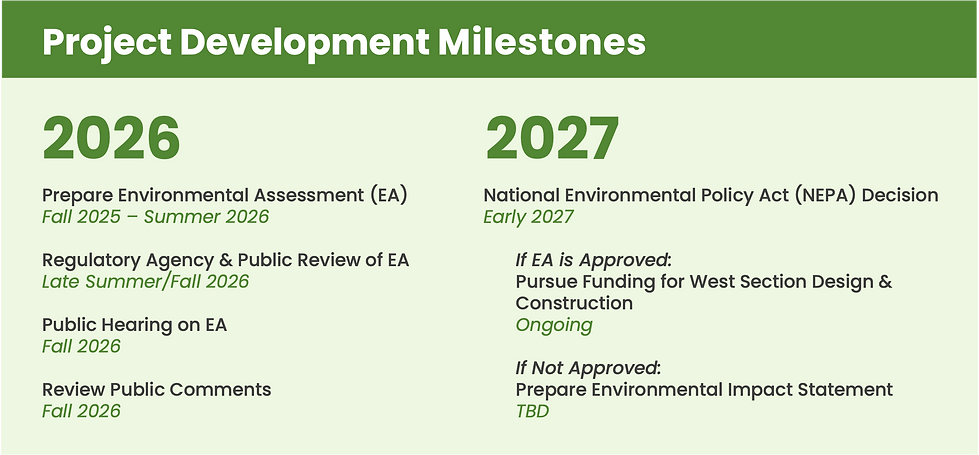
The EA has been provided to state and federal regulatory agencies for review and was released to the public for review in late August 2026. A formal Public Hearing was held on September 10, 2026, to receive comments from the community on the EA and its recommendations. Comments need to be submitted by October 10, 2026, at the close of the 45-day public comment period. More details about the Public Hearing and comment period are provided in the Upcoming Public Input Opportunities section of the Participate page.
Once the public comment period has ended, ODOT – acting on behalf of FHWA – will review the EA in detail and consider all public comments received before making a decision on whether or not to accept the EA and its recommendations.
If the EA is approved, no further environmental review is required and the project will advance to the next stages of development, pending the availability of funding. If the EA is not approved, additional environmental studies will be required. This determination is expected in early 2027.
Phasing & Timing
The NHX project will be built in phases. Specific timing depends on the availability of funding.
The NHX will generally be developed from west to east. Focus will primarily be on the West Section first due to the limitations of the aging Black Street Bridge.
Before work can begin, however, funding is needed for detailed design, utility relocation and right-of-way acquisition. Once funding is obtained, it’s expected that these efforts will take between three and five years to complete. It will take another several years to construct the new bridge. Specific timing for the Central and East Sections is not yet known.
It’s anticipated that it will take 20 to 30 years to complete the NHX in its entirety.
Several intersection improvements have been advanced as individual projects to make local travel easier and safer in the near term and to take advantage of recent funding opportunities. Construction of these smaller initiatives will begin in the next few years. More information is available on the Breakout Projects page.
Funding
Planning and building the NHX in its entirety will be a long-term process. Due to its size and magnitude of cost, the NHX will not be funded all at once. Instead, funding will most likely come from a series of multiple federal, state and local commitments and grants secured over many years.
Although work is expected to progress primarily from west to east, the City and BCTID will pursue funding opportunities for all parts of the project as different funding opportunities become available. At times, this could shift the order in which some parts of the NHX are built.
Funding received to date will allow the City and BCITD to complete the Environmental Assessment process. Funding has also been secured for the construction of several intersection and road improvements on the west side of the Great Miami River. More information is available on the Breakout Projects page.
Currently, the City and BCTID are pursuing additional funding for bridge design and construction in the West Section. An application has also been submitted to fund the construction of a roundabout at the intersection of Princeton Road and Hampshire Drive in the East Section. See the Breakout Projects page for more detail.
